Roughly 42% of people are living with obesity and 11.6% with diabetes today, according to the CDC. Alarmingly, research predicts by 2030, half of all Americans will fall into the obese category. The consequences of this trend are not just a matter of increased healthcare costs: it’s a crisis that significantly diminishes the quality of life for millions, leading to health issues ranging from heart disease and stroke to certain types of cancer and type 2 diabetes. Founded in 2016 by Meng Deng, Ph.D. from Purdue University, Adipo Therapeutics is confronting this crisis head-on. The startup is developing a novel therapeutic to combat obesity and type 2 diabetes by biochemically transforming white fat into calorie-burning brown fat, aiding in weight loss and better blood sugar control.
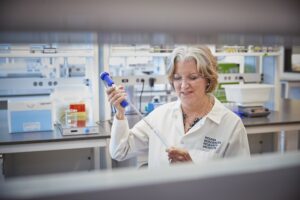
In 2020, the biopharma company sought to assemble a larger team, moving out of its Purdue University lab into a private lab space that fit a constrained startup budget. That’s when CEO Karen Wurster joined the team. “Our company is small, and we only had one full-time scientist in the group, so we wanted to make sure that we had a place where we didn’t feel isolated,” she says. “We wanted to be part of a bigger, innovative startup community to make it a more exciting place to work.”
 Adipo was one of the first tenants to move into the Indiana Biosciences Research Institute (IBRI) in 2020. The research institute located in Innovation Building 1, offers lab space and equipment to start-ups like Adipo looking to transform research into real-world applications that positively impact human health. The space offered not just a fully equipped lab that helps to advance their science, but also a dynamic environment that fosters innovation and interaction within the startup ecosystem.
The support from the IBRI has been a game-changer for Adipo, according to Wurster. The lab’s resources helped the Adipo team advance its science, leading to a significant milestone: securing an additional $1.9 million in funding. To date, Adipo has secured $4 million in seed financing to propel the progress of its primary product, ADPO-002NP. “Both on the science and business side, I feel like we’ve had the advantages of being in IBRI at 16 Tech,” says Wurster. Leveraging the vibrant community and state-of-the-art facilities provided by IBRI at 16 Tech, Adipo is paving the way for new treatments that could significantly alter the landscape of obesity and diabetes management.